Round face haircut guide
Haircuts for Round Face Proportions: A Practical Guide
Rounder visible proportions do not require a “slimming” haircut. The useful question is where you want the silhouette to carry width, height, movement, and open space—and how that structure will behave with your texture and routine.
Try it on your photoOne free Safe Match · No card · Original deleted within 24 hours
Useful directions
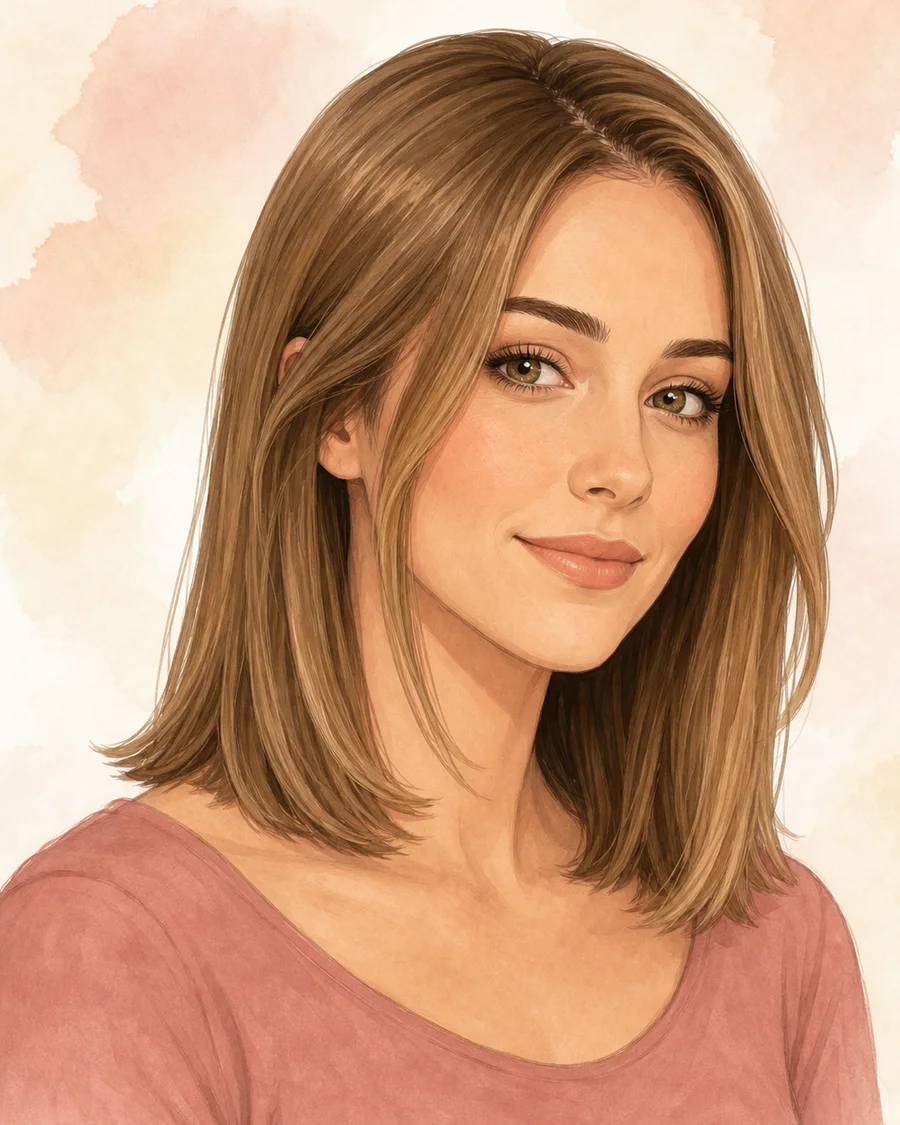
- Collarbone lengths with a clear perimeter or vertical movement
- Off-center parts, open curtain fringe, and longer face framing
- Short cuts whose crown, sides, and outline are deliberately balanced
Check before cutting
- Blanket claims that bobs or full fringe are always unsuitable
- A single heavy horizontal line at an unintended width point
- References that require straightening or volume your routine cannot support
01
Choose where the silhouette should expand
A rounder face description usually refers to visible length and width feeling relatively close, with softer transitions through the jaw. Hair can repeat that softness or introduce a more vertical or angular outline. Volume high at the crown may lengthen the overall silhouette; width at the cheek can echo the face; fullness below the jaw can move the widest point lower. Select the effect rather than following a ban list.
View the head and haircut together. A very flat crown with dense width at the cheeks produces a different balance from a bob that has lift at the top and a clean line below the jaw. The haircut name alone does not tell you which version you are seeing.
02
Use length as a movable landmark
A collarbone perimeter creates a visible line below the face and leaves room for longer vertical movement. A chin or jaw bob can also work when the outline is intentional: slightly longer toward the front, softly textured at the ends, tucked behind one side, or paired with crown lift. The important question is where the perimeter ends relative to the widest area, not whether the word “bob” is allowed.
For a short crop or pixie, compare side width and top height. Close sides with flexible texture on top create one silhouette; a rounded, uniform cap creates another. Ask for side and back references because a flattering front view can hide excessive bulk around the ears or occipital area.
03
Give every layer and fringe a clear job
Long face-framing pieces can create downward movement, while short layers ending at the cheek may add width there. That does not make short layers wrong; it means they should be chosen intentionally. On wavy or curly hair, shrinkage can move the apparent endpoint upward, so discuss dry length and how the shape changes after washing.
Open curtain fringe, side-swept fringe, or an offset part can create diagonal lines. A full blunt fringe creates a strong horizontal line and may produce a graphic, youthful shape some people actively want. Compare the style goal, front density, cowlicks, and trim schedule before committing.
04
Test the ordinary finish, not only the salon finish
Round-face haircut galleries often rely on root lift, smooth bends, and controlled ends. Ask whether that effect comes from layer placement or a blowout. If you air-dry, request a version that shows your natural texture and likely volume distribution. If you enjoy styling, write down the tools and time required so the commitment is explicit.
Use a preview to compare one variable at a time. Try the same collarbone length with an open forehead and with curtain fringe, or the same bob with a blunt and a softened perimeter. This teaches you more than comparing unrelated styles with different length, texture, and finish.
A practical comparison
Collarbone layers or a jaw-length bob?
Both directions can work with rounder proportions. Compare where each places the perimeter, how much styling reveals the shape, and what you want the haircut to communicate.
| Compare | Collarbone layers | Jaw-length bob |
|---|---|---|
| Silhouette | Places the outer line below the face and can use long layers for vertical movement. | Creates a stronger line close to the jaw and can feel graphic, compact, or deliberately rounded. |
| Flexibility | Often preserves tie-back options and allows face-framing pieces to grow into the length. | Changes the outline clearly; tucking, parting, and slight graduation become important styling choices. |
| Texture | Waves and curls can produce movement, but layer height must account for shrinkage and density. | Natural texture can make the perimeter expand; dry-shape planning helps control where width sits. |
| Best question | Where should the shortest layer start so it moves without adding unintended cheek width? | Should the line sit at, above, or below the jaw, and should it be blunt, softened, or longer in front? |
Use this page
A step-by-step decision check
-
Step 1
Mark the intended width point
On a reference, identify where the hair is fullest: crown, temple, cheek, jaw, or below the jaw. Decide whether that placement matches your goal.
-
Step 2
Compare two perimeters
Preview a line below the jaw and one closer to it while keeping texture and fringe similar. This isolates the effect of length.
-
Step 3
Check dry texture
Consider shrinkage, expansion, and parting after washing. Ask for dry-length landmarks when natural texture changes the apparent outline.
-
Step 4
Plan the front pieces
Choose the shortest face-framing point and verify whether it tucks back, joins a ponytail, or needs daily shaping.
Questions to take to your stylist
Use these as conversation starters. Your stylist can inspect the hair in person and choose the technique.
- Where will this cut carry the most width when my hair is air-dried?
- Should the perimeter sit above, at, or below my jaw to create the intended line?
- How will my shrinkage or natural wave change the shortest face-framing pieces?
- Can the crown shape shown in the preview be achieved by the cut, or does it require styling?
- What would you alter if I want this silhouette but need easy tie-back and longer grow-out?
Frequently asked
What to know before you choose
Can a round face wear a bob?
Yes. “Bob” covers many outlines. Compare jaw, chin, and collarbone lengths; blunt or softened ends; crown and side volume; parting; and whether the front is slightly longer. Choose the version that creates your preferred silhouette.
Do curtain bangs work with rounder face proportions?
They can. The opening, shortest point, side length, and front density matter more than the trend name. Longer, open pieces create different lines from a short, closed curtain fringe and usually have an easier grow-out.
Should volume always be placed at the crown?
No. Crown lift is one way to create a more vertical outline, but side or lower volume can be intentional and expressive. Place volume according to your preferred shape, texture, and styling routine.
How can I compare styles without using “slimming” language?
Describe visible design effects: where the perimeter ends, where the hair is fullest, whether lines feel vertical, diagonal, rounded, or graphic, and whether the forehead or jaw is open or framed.
See it before you decide
Start with one free Safe Match
Upload first, review the explanation and identity match, then decide whether another direction is worth one credit.
Upload a selfie